Hi, I'm Dr. Chantel Martin
I study how our social environments and experiences become biologically embedded or “get under the skin” to shape our health.

Curiosity became a career in epidemiology
My career didn't begin in public health. After studying finance and economics at the University of Delaware, one post-baccalaureate course introduced me to epidemiology, and everything changed. I became captivated by a simple question: Why do communities experience health so differently? Epidemiology gave me the tools to pursue this question with data, and it continues to shape every aspect of my research today.
Chantel Martin is a Tenured Associate Professor at the Gillings School of Global Public Health and Faculty Fellow at the Carolina Population Center at the University of North Carolina at Chapel Hill. Chantel's research interests explore the ways in which inequitable social environments and different lived experiences shape our health and produce health disparities. Her research probes critical areas like socioeconomic conditions, racism, segregation, housing affordability, neighborhood conditions, and crime and policing to better understand how our disparate environments can make us sick.

Ways we can work together
Whether you're designing a study, collecting or analyzing data, needing a speaker, or growing as a scientist, here's how I show up:
Research, Consulting, and Collaboration
I lead studies from a lens of health equity on social environment, epigenetics, chronic disease risk, and healthy aging across the life course, tracing how social and environmental stressors “get under the skin” to impact health and disparities.
Speaking
From keynotes to seminars, I translate complex science into information people can carry home. I partner with conferences, universities, and organizations.
Mentorship
I invest in the next generation of scientists and build cross-disciplinary teams, because these questions are too big for any one of us alone.
Science in service of community
My work is committed to communities disproportionately impacted by structural inequities, particularly Black communities. By understanding how neighborhood conditions, segregation, and environmental stressors get under the skin, I aim to build the evidence for earlier, more equitable prevention strategies and policies that let every community thrive.
Featured talks
Invite me to speakInvited Research Seminar
University of Arizona
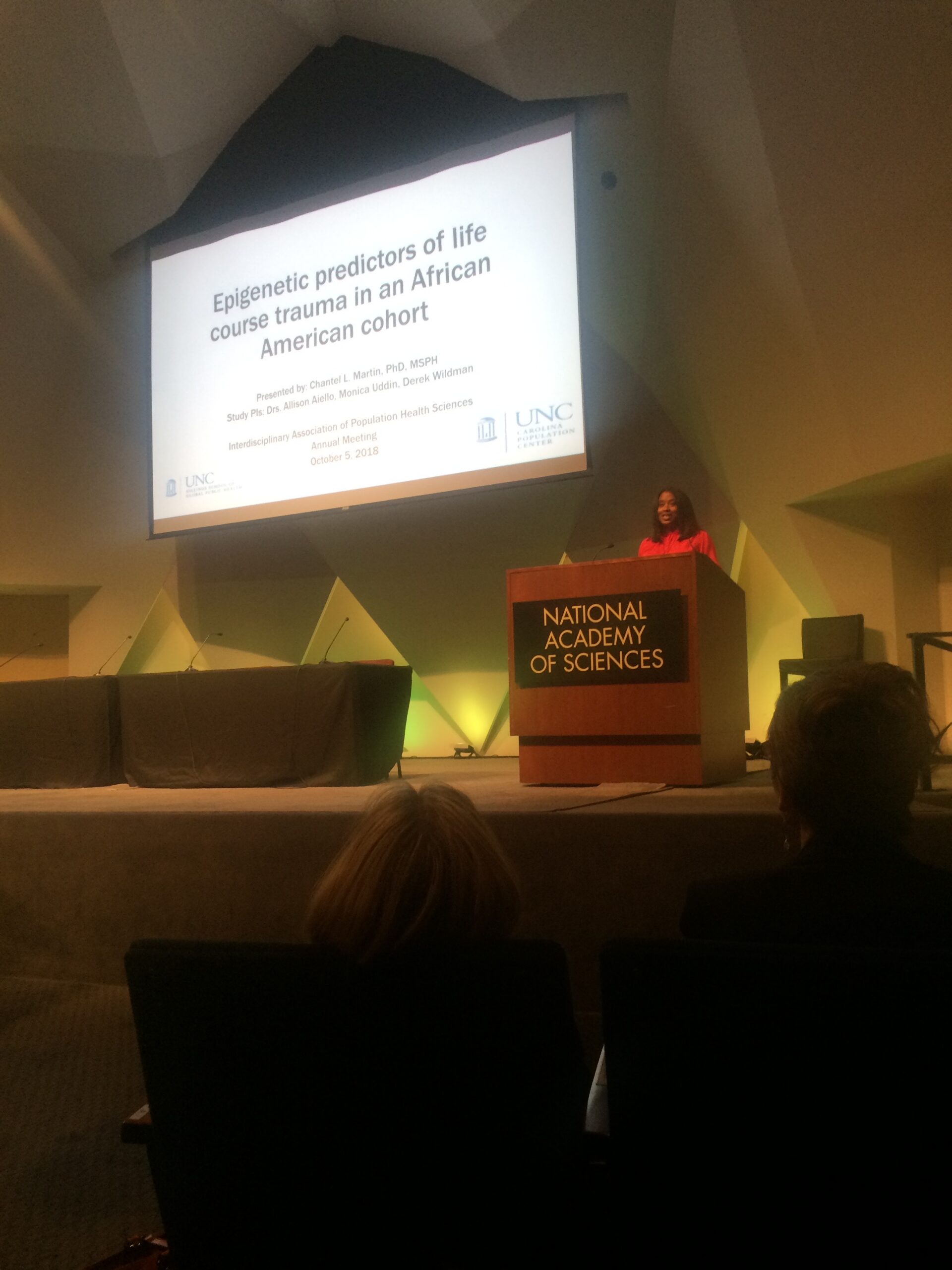
Research Panel
National Academy of Sciences
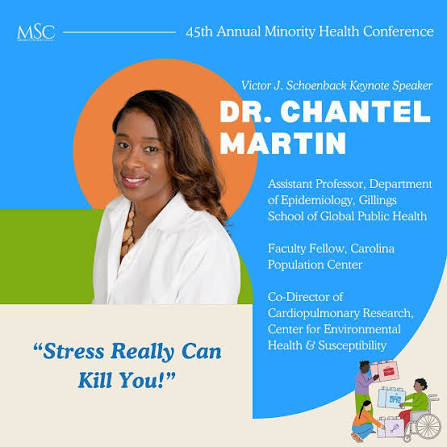
Keynote Address
45th Annual Minority Health Conference
Recent publications
View Full BibliographyHargrove TW, D'Alessio AS, Tuder S, Harrell A, Gaydosh L, Kelly AL, Aiello AE, Mullan Harris K, Levitt B, Martin CL. Adolescent structural disadvantage and biological aging in early midlife. JAMA Network Open. 2026; 9(5):e2611913
Martin CL, Dhingra R, Chen J, Ye A, Lodge EK, Maguire R, Ghastine L, Dhingra R, Hoyo C. Gestational exposure to neighborhood police-reported crime and umbilical cord blood DNA methylation: An epigenome-wide association study and regional analysis. Epigenetics, 2025, 20(1): 511553
Ghastine L, Sealy-Jefferson S, McClure ES, Hoyo C, Martin CL. Neighborhood evictions, household children, and preterm birth among Black birthing people. BMC Public Health, 2025; 25(1): 4294
Cowan KN, Haight SC, Edwards JK, Luben TJ, Martin CL. Does choice of neighborhood disadvantage index matter? An application with preterm birth disparities in North Carolina. Annals of Epidemiology, 2025; 107: 54-60
Martin CL, Ghastine L, Wegienka G, Wise L, Baird D, Vines A. Early life disadvantage and the risk of depressive symptoms among young Black women. Journal of Racial and Ethnic Health Disparities, 2024; 11(3): 1819-1828
Atere-Roberts J, Delamater PL, Robinson WR, Aiello AE, Hargrove TW, Martin CL. Indicators of inequity: Exploring the complexities of operationalizing area-level structural racism. Social Science and Medicine-Population Health, 2024; 27: 101701
Haight S, Ghastine L, Maselko J, Hoyo C, Martin CL. Residential segregation and prenatal depressive symptoms among non-Hispanic Black and Hispanic mothers in North Carolina. Annals of Epidemiology, 2023; 83: 15-22
Martin CL, Ghastine L, Lodge EK, Dhingra R, Ward-Caviness C. Understanding Health Inequities through the Lens of Social Epigenetics. Annual Review of Public Health, 2022; 43: 235-254
Lodge EK, Haji-Noor Z, Gutierrez CM, Aiello AE, Hoyo C, Emch ME, Martin CL. Gestational exposure to neighborhood police-reported crime and early childhood blood pressure in Durham, NC. Health & Place, 2022; 75: 102800
In the media
PressMinority Health Conference focuses on social determinants of health · NC Health News
FeatureHow racism gets beneath the skin · Carolina Public Health
ResearchEducation and social support and depression among Black women · UNC Gillings News
Honors & awards
Secured more than $5 million in competitive research funding as a principal investigator
Over 80 peer-reviewed publications in top-tier science journals with more than 1,800 citations
Awards from ASPPH, ABMR, NIH, and UNC for innovative science in health equity, social epigenomics, and social epidemiology
Features in national and local media
More than 25 research presentations and keynote addresses